
Let's start with the honest part
Yes, a lemon vibrator feels different with your partner than it does alone. Not because the toy changes. Because you change. Your nervous system activates differently when someone else is present, touching you, watching you, or holding the toy. That shift is partly physical and partly psychological, and it's completely normal.
Here's what I see in my practice: people expect that adding a partner to solo pleasure will automatically make it better. Sometimes it does. Often it's more complicated than that. Understanding what's actually shifting helps you navigate the difference with less confusion and more intentionality.
The anticipation factor
When you're using a lemon vibrator alone, the arc is straightforward. You know your own rhythm. You know roughly when you'll come. There's a kind of certainty built into the solo experience.
With a partner, uncertainty enters. Even if you've done this a hundred times, there's a layer of "what will they do next?" or "how fast will they move it?" or "will they slow down or speed up?" Your brain is processing input from outside yourself, not just managing internal sensation.
That uncertainty activates your parasympathetic nervous system differently. Some people find it distracting in the worst way. Others find it electrifying. The good news is that this response is learnable. The more you practice using a lemon clitoral vibrator with your partner, the faster your nervous system settles into anticipation as pleasure rather than distraction.
One practical shift: many couples find that explicitly talking about what's coming next removes the cognitive load. "I'm going to start slow and move up to pattern 3" is more relaxing than mystery. Your brain can release into sensation instead of bracing for the unknown.
The vulnerability shift
Using any clitoral vibrator alone is private. Using one with a partner is exposure. Your body is doing something visible. Your partner is watching your face, your breath, the way you move. That visibility changes the entire experience for most people.
This is where shame or self-consciousness can sneak in if you're not paying attention. I've worked with so many couples where the person with the vulva is genuinely more aroused alone, not because the toy feels better, but because they're not managing a running internal commentary about how they look, whether their sounds are weird, or if their partner is bored.
The antidote is gradual exposure and reassurance. Start with the toy somewhere less visible. Use it over underwear first. Let your partner hold it instead of you, so your hands are free to touch them or cover your face if you need to. Vulnerability isn't binary. You build it in layers.
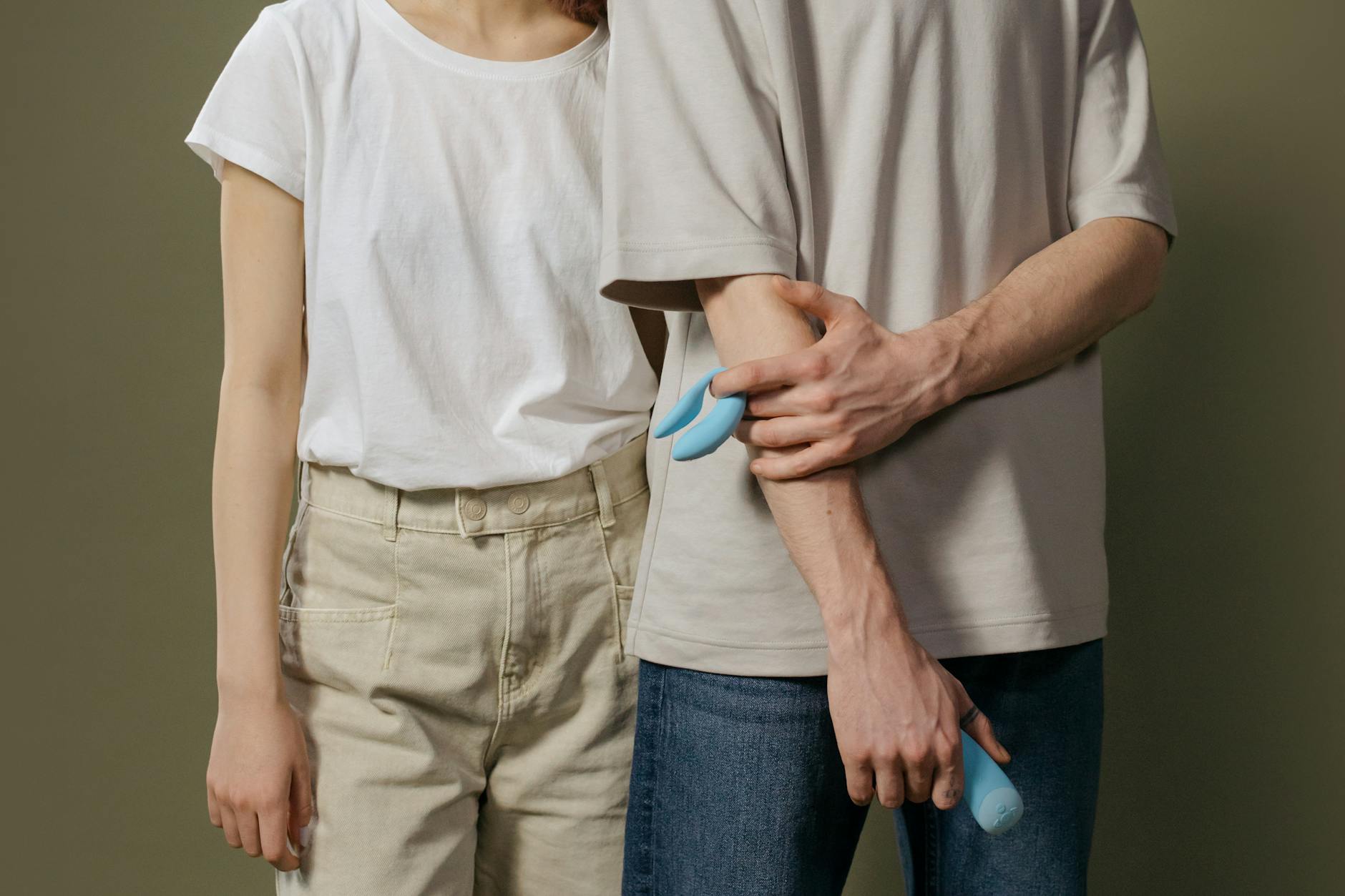
Photo by cottonbro studio on Pexels
The rhythm mismatch problem
Here's something nobody warns you about: when a partner is holding the lemon vibrator, they're not you. They don't know your rhythm. They'll start too slow or too fast. They'll keep the pressure constant when you actually want it to pulse. They'll miss the exact angle that works.
That's not their fault. It's just information asymmetry.
The solution is communication, but not the vague kind. Not "a little faster." Instead, be specific. "Stay on pattern 2 for another 30 seconds" or "move it slightly to the left" or "I need you to stay still and let me move against it." When you're teaching your partner how to use the lemon clitoral vibrator on you, you're not being demanding. You're giving them the map to your pleasure.
Many couples find that the person receiving pleasure actually holds the vibrator while the partner provides other kinds of touch. Hands, lips, conversation. That way you maintain control over intensity and angle, and your partner focuses on the parts of connection that can't be replicated by a toy.
The pleasure comparison trap
I want to address the thing nobody says: your orgasms with a partner using a lemon vibrator might not be as intense or quick as solo ones. That doesn't mean they're less valuable. It means they're different.
Solo orgasms are often faster because there's zero cognitive overhead. You've got full autonomy over pressure, angle, speed, timing. The pathway is direct. With a partner, you're splitting attention. Some of that attention is pleasure. Some of it is managing vulnerability, navigating communication, processing their presence.
What you often gain instead is a sense of shared witness. Your partner is present for something that's yours. That carries its own weight. Over time, many couples report that the emotional integration makes partnered pleasure feel richer, even if the physical intensity takes longer to build.
The trap is believing that if it doesn't feel "better," something is wrong. You might just be in the learning phase.
When to introduce a lemon vibrator to partnered sex
Timing matters. Using a clitoral vibrator alone first, extensively, is important. You need to know your own body's map before you're teaching someone else to read it. When you're choosing the right lemon vibrator for your needs, you're also deciding what feels good in isolation.
The transition to partnered use works best when there's already solid communication in place. If you and your partner struggle to talk about regular sex without shutting down, adding a toy won't fix that. It'll just add another layer of complexity.
Start in a low-pressure context. Not during the moment you really want to come. Maybe during foreplay when the goal is exploration, not orgasm. Let your partner see the toy in action on you first, in private. Answer their questions. Then try it together.
Solo vs. partnered: making peace with the difference
Honestly, you don't have to choose. Many people use lemon vibrators solo and also with a partner. They're different experiences serving different needs. Solo is efficiency, total control, private pleasure. With a partner, it's connection, vulnerability, shared discovery.
The couples who seem happiest are the ones who've made peace with both modes. Your partner isn't a replacement for your solo practice with the lemon clitoral vibrator. They're an addition to it. You still deserve that private time with your body. And you also deserve to know what pleasure feels like when someone else is in the room.
Common questions about lemon vibrators and partners
Does my partner need to be the one controlling the toy?
Not at all. Many couples find that the receiving partner holds the vibrator while the partner provides manual touch, oral sex, or just emotional presence. Whoever has better control over pressure and angle should hold it. That's often you.
What if my partner feels replaced or less useful?
This comes up often. The solution is making space for both kinds of touch. The toy does one thing very well. Your partner does other things well. Oral sex, penetration, hand pressure, psychological arousal, verbal feedback. A vibrator is not a replacement. It's one part of a full toolkit.
How do I bring up using a lemon clitoral vibrator if my partner might feel threatened?
Frame it as exploration, not feedback on what's been missing. "I want to try something new" lands differently than "I need this because you're not enough." And consider bringing it up outside the bedroom. In conversation over coffee is less vulnerable than mid-intimacy.
Can we use the lemon vibrator during penetration?
Yes, if the angle works. Many people use clitoral vibrators during partnered sex to add simultaneous clitoral stimulation. It takes some coordination and experimentation to figure out the positioning, but it's absolutely possible.
Will using a lemon vibrator make me less sensitive to my partner's touch?
No. Different nerves, different stimulation patterns, different outcomes. Your body doesn't become desensitized to a partner's hands because you've used a vibrator. That's not how neural pathways work.
What if I come faster with the lemon vibrator than during partnered sex?
That's normal and doesn't mean partnered sex is worse. It means the clitoral stimulation from a vibrator is more direct. Many people combine them. Use the vibrator during partnered sex instead of treating them as separate activities.
The real shift
The biggest difference between solo and partnered lemon vibrator use isn't physical. It's psychological. You're less alone. Someone is witnessing your pleasure. That comes with vulnerability and also with a kind of validation. Your pleasure matters enough that they're here, learning your body, trying to get it right.
That doesn't make it automatically better. But it makes it different in ways that, with patience and communication, often deepen over time. The first time might feel awkward. By the fifth time, your nervous system settles. By the twentieth time, you might find yourself looking forward to that specific kind of connection.
Give it space to develop. And if it never feels good with a partner, that's information too. Some people prefer solo pleasure with a lemon clitoral vibrator, and that's completely valid. The goal is knowing what you want and communicating that clearly.
FAQ
Will my lemon vibrator work the same way in partnered situations?
Yes. The toy doesn't change. Your sensation of it changes because you're in a different mental and emotional state. The intensity settings on your lemon vibrator remain the same. How your body responds to those settings will vary depending on context. Understanding lemon vibrator intensity settings can help you navigate both solo and partnered use.
Is it normal to need the vibrator to orgasm when a partner is involved?
Completely normal. Many people come from clitoral stimulation during partnered sex, whether that's manual, oral, or with a toy like a lemon clitoral vibrator. It doesn't mean anything is wrong. Penetration alone doesn't reliably produce orgasms for most people with vulvas, so adding clitoral stimulation is actually the most common way people come during sex with a partner.
Should I tell my partner how to use the lemon vibrator on me?
Yes. Be specific. "Keep it on pattern 2" or "move it in small circles" or "let me guide your hand" are all clear instructions. Your partner is not a mind reader, and you're not being demanding by explaining how to touch your body effectively.
Can we use a lemon sucker-style vibrator during other partnered activities?
Absolutely. Many suction vibrators can be used during oral sex, penetration, or while your partner is using their hands elsewhere. The key is positioning and communication so nobody gets uncomfortable.
What if my partner wants to use the lemon vibrator but I'm not comfortable with that?
That's a conversation for outside the bedroom. Talk about what discomfort comes from. Fear they'll hurt you? Vulnerability? Lack of trust? Different concerns need different solutions. Learning how to use a lemon vibrator with your partner starts with communication.
How long does it take to get comfortable using a lemon clitoral vibrator with a partner?
It varies. Some people feel good about it after one try. Others need three or four sessions to relax into it. Some never feel comfortable, and that's valid information about what you want in partnered sex. There's no timeline. Just patience.
Moving forward
Using a lemon vibrator with a partner is learnable. It doesn't have to be perfect the first time. Start with curiosity instead of expectation. Ask questions. Listen to feedback. Adjust. The couples who navigate this most gracefully are the ones who treat it like any other new skill. You're learning together.
If you're ready to explore, start with a vibrator you actually love using alone. You can't teach a partner to use something you're not confident with. And if you need guidance on selecting the right tool for your body, we're here to help.
Your pleasure with a partner matters. So does your solo pleasure. Both are worth your time and attention.